Water Heater Replacement & Installation in Arvada, Colorado
Replacing a water heater is a fifteen-year decision made in about two hours, usually under pressure, often on the worst day of the month. This page slows that decision down: when replacement is actually necessary, what to buy, where it should go, what it should cost in Arvada, and what a correctly executed replacement or new installation includes — from a like-for-like swap to a first-time install in a new Candelas build.
- Same-day tank availability
- Arvada permit & inspection included
- Right-sized, not upsold
- New builds, remodels & relocations
- Expansion tank & code updates
- Old unit hauled away
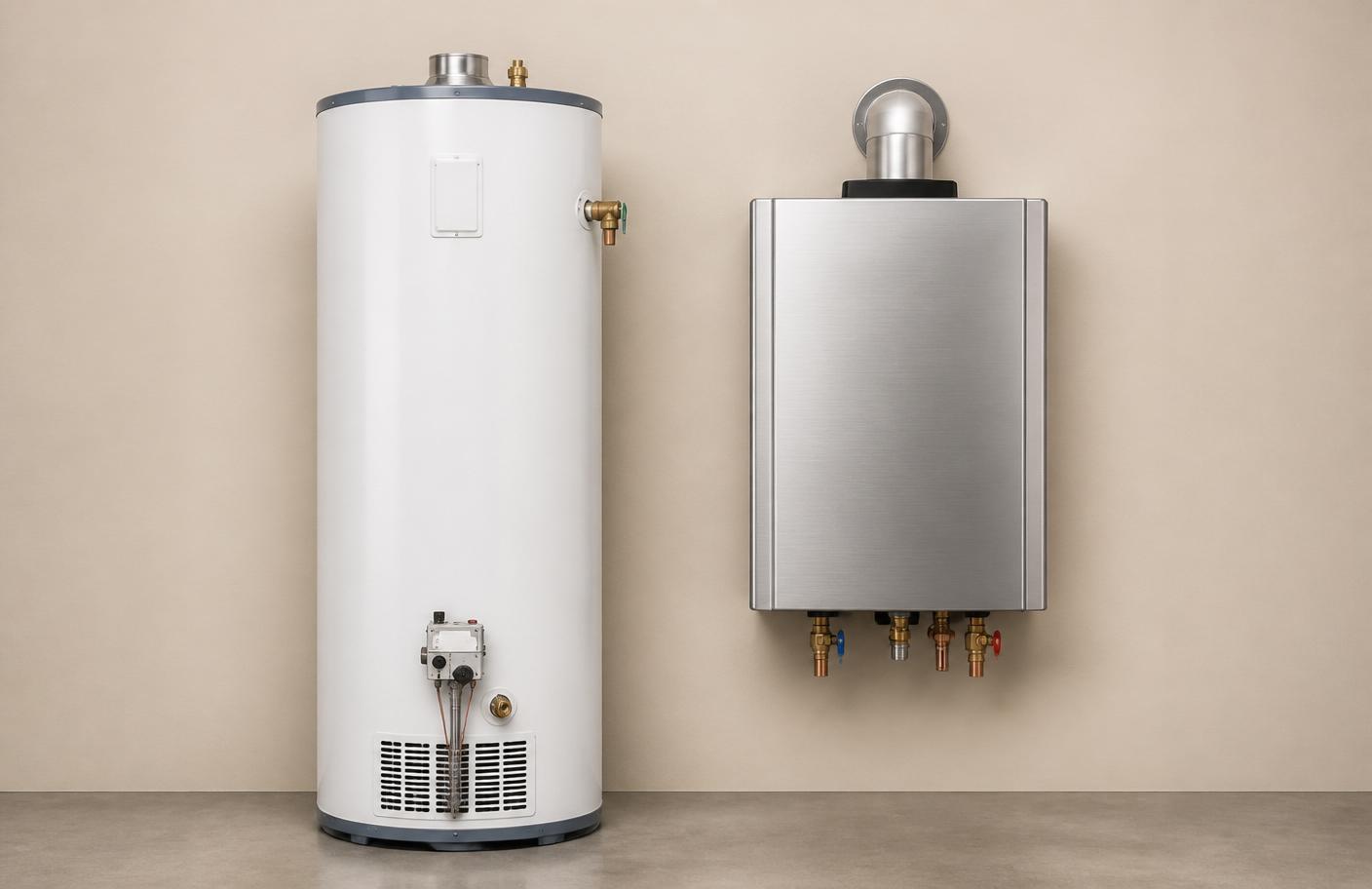
Water Heater Replacement and Installation in Arvada
There comes a point in every Arvada water heater's life where more repair money is bad money. Usually it arrives somewhere between year eleven and year fourteen, and usually it announces itself as a rust ring at the base of the tank or a third service call in eighteen months. When that day comes, what you want is not a salesperson — it is someone who will size the replacement correctly, install it to code, and be gone before dinner.
The other half of this page is installation. Sometimes there is no old unit to match: a new build in Leyden Rock, an addition or ADU, a basement finish that puts the heater inside living space, or a relocation out to the garage. Installation is a different discipline from replacement, because every decision is open rather than inherited — where it goes, how it vents, how it drains, what fuel it uses, and how someone will service it in year nine.
Both carry Arvada specifics that generic advice misses. The city requires a permit and inspection, and new-location work draws more scrutiny than a swap because the venting, gas and discharge routing are all new. Our moderately hard water makes tank material quality and anode access genuinely worth paying attention to. Our 5,300-foot elevation requires gas units to be set up for altitude and changes combustion-air math. And Arvada's housing stock — 1950s ranches near Olde Town through 2020 builds in Candelas — means the venting and gas situation varies enormously from one street to the next.
Below is the complete reference: when replacement is necessary, the installation process step by step, code compliance and permits, proper sizing, gas versus electric, tank versus tankless, removal and disposal of the old unit, realistic timelines, real Arvada pricing, what to expect on the day, and the maintenance that determines whether your new heater lasts ten years or sixteen.
What Water Heater Replacement and Installation Includes
A water heater replacement is not a swap, and an installation is a design problem before it is a plumbing problem. The difference between a good one and a cheap one shows up in years eight through fifteen rather than on the invoice.
Every job we perform in Arvada starts with a load assessment: how many people live in the home, how many bathrooms, whether there is a soaking tub or body-spray shower, whether laundry and showers overlap, and what the winter inlet temperature does to recovery. That produces a first-hour rating target, which produces a correct unit size. We do not simply match whatever was there before, because that unit was often sized for a different family — and on a first-time or new-construction install there is nothing to match at all, so proper sizing is the whole job.
Next comes placement. In Arvada we most often install in unfinished basements, mechanical rooms, garages and — in townhomes — interior utility closets. Each has implications. A basement location is convenient but sits under living space. A garage keeps failures away from finished areas but requires elevation of ignition sources on gas units and freeze protection on exterior walls. A closet almost always means power-vent, because natural draft in a sealed space does not work at our altitude. Where the unit lives also determines how easily a technician reaches the anode port and drain valve in year nine.
Then fuel and type. If gas is available and adequately sized, an atmospheric or power-vent tank is the economical route. If the home is all-electric or gas is far from the location, a resistance or heat pump unit makes more sense. If floor space matters or the household is large, tankless becomes worth the gas and venting investment. We work this out against your household's real demand rather than a rule of thumb.
From there we evaluate the infrastructure. Is the existing vent properly sized and pitched? Is there enough combustion air for an atmospheric gas unit, or does this home need a power-vent? Does the gas line have the capacity and length for the BTU load? Does the electrical panel have headroom for a heat pump unit? Is there an expansion tank, and is it still holding charge? Is the TPR discharge routed legally, and is there a drain pan piped somewhere useful? These are the items an inspector catches and a rushed installer ignores.
Then the work itself: permit pulled, water and fuel isolated, old unit drained and removed, any new water, gas, electrical, vent and condensate infrastructure roughed in and pressure-tested, new unit set on a proper stand or pan, dielectric connections made, expansion tank installed or verified, gas line leak-tested, unit filled, purged of air, fired and tuned for our 5,300-foot altitude, temperature verified at the tap, inspection passed, warranty registered in your name, and the old heater hauled away and recycled.
Water Heater Sizing Guide
First-hour rating calculated against Arvada's winter inlet temperature, not a generic sea-level chart.
Water Heater Placement and Installation Planning
Where the unit goes, how it drains, and how a future technician will reach the anode port and drain valve.
Gas vs. Electric Water Heater Installation
Line sizing and extension, circuit capacity, vent path construction, termination clearances and condensate routing.
Water Heater Permits and Code Compliance
City of Arvada permit pulled and inspection met. Expansion tank, TPR discharge, dielectric unions, drain pan, seismic strapping and garage ignition-source elevation where required.
Water Heater Installation Commissioning
Altitude setup, temperature calibration, pressure-tested connections, and manufacturer warranty registered in your name.
Old Water Heater Removal and Disposal
Old unit drained, carried out and recycled. No disposal surcharge, no tank left in the driveway.
When Water Heater Replacement Is Necessary
These are the conditions that bring Arvada homeowners to a replacement or installation decision — from a failing tank to a basement finish, a new build or a first-time install. Some are emergencies, most are not, and the ones that are not are the ones you want to act on.
Leaking Water Heater Tank
Water seeping from a seam or the shell itself is the one truly unrepairable failure. The glass lining has broken down and steel is corroding through. No valve, element or gasket addresses it.
Repeat Water Heater Repairs
Two or more paid repairs in two years on the same unit usually means the underlying condition is age, not components. Each fix buys months while the tank keeps deteriorating.
Persistent Rusty Hot Water
If discolored hot water continues after an anode replacement and a full flush, the corrosion has moved from the sacrificial rod to the tank itself. That is a countdown, not a condition.
Water Heater Too Small for the Household
A 40-gallon tank in a four-bedroom Candelas home with two teenagers was never going to work. No repair fixes a sizing problem — only the right replacement does.
High Energy Bills From an Old Water Heater
Gas bills climbing with no change in usage means longer burn cycles fighting through sediment and a degraded burner. Late-life tanks can run 20–30% less efficiently than new.
Water Heater Age (10+ Years)
Past year eleven in Arvada water, a tank is running on borrowed time. Replacing before it fails costs the same as replacing after — minus the water damage and the emergency premium.
Venting and Code Violations
Improper vent rise, missing expansion control, illegal TPR routing. Sometimes replacement is the practical moment to correct a decade of accumulated installation shortcuts.
Switching to Tankless or Heat Pump
Reclaiming basement floor space with tankless, cutting operating cost with a heat pump, or moving the heater out of a finished area entirely.
Water Heater Replacement Before Selling a Home
A thirteen-year-old water heater is a standard inspection callout in Arvada real estate. Replacing before listing removes a negotiating lever from the buyer's side.
Water Heater Replacement During a Basement Remodel
The heater suddenly sits inside conditioned living space with carpet and drywall around it. Relocation, a drain pan with a piped drain, or both become genuinely important rather than optional.
New Construction Water Heater Installation
Candelas, Leyden Rock and Whisper Creek builds where we coordinate rough-in with framing and the other trades so nothing has to be reopened later.
First-Time Water Heater Installation
A new suite, a mother-in-law unit or a converted garage often needs its own dedicated water heater rather than straining a system sized for the original house.
Gas Line Undersized for a New Water Heater
The most common surprise on Arvada installations. An existing half-inch line that fed a 40-gallon tank will not support a tankless unit or a 75-gallon heater without upsizing.
Power-Vent Water Heater Installation
Interior closets in older Arvada homes frequently cannot supply adequate combustion air at 5,300 feet. Power-vent or a sealed direct-vent unit is the correct answer.
Electric Water Heater Circuit and Panel Capacity
Heat pump and large electric units need dedicated capacity. Older Arvada panels sometimes need a subpanel or an upgrade first, which we identify before quoting.
Drain Pan and Drainage Requirements
Many Arvada basements have no floor drain near the heater. A pan is only useful if it is piped somewhere, which often means a condensate pump.
Signs You Need a New Water Heater
A tank that is going to fail generally gives you between three months and a year of increasingly obvious notice. And if you inherited the installation with the house, a second list matters just as much: the signs the original work was never done to code and should be corrected while the unit is being replaced.
- Rust ring or mineral crust at the base of the tank
- Moisture on the floor that returns after you wipe it
- Hot water that turns rusty after the tank sits overnight
- Age of eleven years or more on the rating label
- Loud rumbling that persists after a professional flush
- Corrosion creeping down from the top nipples
- Recovery so slow that a second shower is always cold
- TPR valve discharging repeatedly under normal operation
- Visible bulging or deformation of the tank jacket
- A previous plumber has already told you it is near the end
- Rising gas or electric bills with unchanged household use
- A finished basement below or beside the heater
- No expansion tank on a closed plumbing system
- TPR discharge terminating in the pan or well off the floor
- No drain pan under a unit sitting above finished space
- Vent connector with inadequate rise or a downward slope
- Gas water heater in a closet with no combustion air louvers
- Ignition source at floor level in a garage installation
- Copper threaded directly to steel nipples with no dielectric union
- No permit or inspection record for the existing installation
Why Arvada Water Heaters Fail Early
Tanks in Arvada reach end of life for identifiable reasons, and when a fairly new unit fails early it is almost never the equipment — it is an installation decision made wrong. Knowing both is what lets you get sixteen years out of the next heater instead of ten.
Water Heater Sediment Buildup
Arvada's mineral content settles as a hardened layer on the tank floor. It insulates the burner from the water, drives the steel temperature up and accelerates the breakdown of the glass lining that protects the tank.
Anode Rod Never Replaced
Once the sacrificial anode is consumed — typically around year five here — corrosion transfers directly to the tank wall. The overwhelming majority of tanks we replace still have their original rod, fully spent.
Thermal Cycling and Tank Fatigue
Every heating cycle expands and contracts the steel. Fifteen years of that, with Arvada's cold winter inlet water widening each swing, produces the microscopic fissures that eventually become a leak.
No Expansion Tank on a Closed System
Where a backflow preventer or pressure-reducing valve creates a closed system, thermal expansion has nowhere to go. Pressure spikes stress the tank seams and the TPR valve every single cycle.
Water Heater Undersized From Day One
A heater constantly running at full output to keep up with a household never gets a rest cycle. It burns through its service life faster than the same unit in a home that suits it.
Improper Original Water Heater Installation
Missing dielectric unions cause galvanic corrosion at the nipples. Inadequate vent rise causes condensation to run back down onto the burner. We inherit both regularly in Arvada homes.
Thermostat Set Too High
A dial pushed to 140°F or beyond dramatically accelerates scale formation and shortens tank life, and it is the most common way homeowners compensate for a capacity problem.
Water Heater Age
Even a well-maintained tank in good water is a consumable appliance. Fourteen to sixteen years is an excellent run in Arvada. Nothing lasts forever inside a steel vessel full of hot mineral water.
Gas Line Sizing for Water Heater Installation
A line that adequately fed a 40,000 BTU tank will starve a 199,000 BTU tankless. Undersized supply produces ignition faults, temperature swings and premature component failure that look like defects but are not.
Water Heater Venting Done Incorrectly
Vent diameter, total length, elbow count and rise all matter, and they matter more at Arvada's altitude than at sea level. Marginal venting causes backdrafting, condensation on the burner and nuisance shutdowns.
Combustion Air Requirements at Altitude
At 5,300 feet the same closet supplies meaningfully less oxygen. A gas unit installed in a sealed space without engineered makeup air will soot, short-cycle and eventually fail its gas valve.
Poor Water Heater Placement
Installers put the heater where it is easiest to set, not where a failure would do least harm or where service access would be simplest. Arvada homeowners pay for that in year twelve.
Garage Water Heater Freeze Protection
Garage and exterior-wall installations in Arvada see real sub-freezing exposure. Uninsulated lines and unprotected condensate drains cause winter failures every single January.
Unpermitted Water Heater Installation
Unpermitted work in Arvada creates problems at resale, can complicate insurance claims, and removes the one independent check that the job was actually done right.
Choosing the Right Water Heater: Gas, Electric, Tank or Tankless
There are more replacement and installation options than most homeowners realize, and the right one depends on your household, your utility connections, where the unit will live and how long you plan to stay in the house.
Gas Water Heater Replacement
The default for most Arvada homes with an existing gas line and adequate venting. Lowest install cost, fast recovery, every part readily available. 40, 50 and 75-gallon capacities.
Power-Vent Gas Water Heater Installation
For utility closets and interior locations where natural draft is not viable. Vents horizontally through a sidewall with PVC. The standard answer for tight Olde Town and Club Crest installations.
Electric Water Heater Replacement
For townhomes, condos and homes without gas at the heater location. Lower install cost, simple to service. We size up to offset the slower recovery rate.
Heat Pump (Hybrid) Water Heater Installation
Two to three times the efficiency of resistance electric, and eligible for federal credits. Needs adequate surrounding air volume and a condensate drain — an unfinished Arvada basement is close to ideal.
Tankless Water Heater Conversion
Endless hot water, roughly 18–22 years of life, and the floor space back. Requires gas line evaluation, dedicated venting and a commitment to annual descaling in our water.
High-Capacity 75–80 Gallon Water Heater Installation
For larger Candelas and Leyden Rock homes with multiple simultaneous demands, soaking tubs or high-flow shower systems where a 50 will never keep up.
Water Heater Relocation
Moving the heater out of a finished space, into the garage or to a better-drained location. The replacement appointment is by far the cheapest moment to do this.
High-Efficiency Water Heaters and Extended Warranties
The 12-year model on the same shelf usually carries a thicker anode and better lining than the 6-year. In Arvada water that upcharge pays for itself more often than not.
Hot Water Recirculation Loop Installation
For long runs to a master bath. Eliminates the ninety-second wait for hot water and, on a timer or demand control, without wasting energy around the clock.
New Water Heater Installation in a New Location
Complete build-out where no heater existed: water line extension, gas or electrical run, vent path, drain pan with piped drainage, expansion tank, shutoffs and commissioning.
New Construction Water Heater Rough-In
Coordinated with your builder's schedule in Candelas, Leyden Rock and Whisper Creek. We specify against the finished home's demand, rough in during framing, then set and commission before final.
Gas Line Sizing and Extension
Load calculation across all appliances, correct pipe sizing for length and BTU demand, and pressure testing before anything is connected.
Drain Pan and Leak Protection Installation
Pan with a piped drain to a floor drain, sump or condensate pump, plus optional automatic leak-detection shutoff valves for units over finished space.
Water Heater Repair vs. Replacement
Not every aging heater needs replacing this month. Here is the honest split we use when we are standing in front of your unit in Arvada.
You can reasonably wait
- The tank is under nine years old and completely dry
- The only issue is a single failed component
- Capacity still comfortably meets your household demand
- The unit sits in a garage or unfinished space with a floor drain
- There is no rust in the hot water and no crust at the base
- A flush and anode replacement are still viable
Replace now
- Any water is coming from the tank body itself
- The heater is eleven years old or more
- It sits above or beside finished living space
- You've paid for multiple repairs in the last two years
- Rusty hot water persists after service
- You're listing the home in the next twelve months
Our rule of thumb
The Water Heater Installation Process
A same-location replacement is a half-day project done properly; a new-location installation is a full day, occasionally two. Either way, the sequence is the same and you know the timeline before we start.
- 1
Water Heater Sizing and Site Assessment
We walk the space, measure clearances, verify gas capacity and electrical headroom, evaluate vent routes and drainage, and talk through how your household actually uses hot water. That produces a specific recommendation and a placement plan, not a catalog.
- 2
Written Proposal and Permit
You get an itemized fixed price including unit, labor, the City of Arvada permit, expansion tank, infrastructure scope and any code corrections. Nothing is ordered and no work starts until you approve it.
- 3
Installation Scheduling
We pull the permit and, on new builds and remodels, coordinate with your builder, electrician or remodeler so the work lands in the right sequence rather than holding anyone up.
- 4
Old Water Heater Removal and Disposal
Water and fuel shut off and verified, the old tank drained, disconnected and carried out on protective floor covering. On new locations we then build the water lines, gas or electrical, vent path, condensate routing and drain pan, and pressure-test everything before the unit is set.
- 5
Setting the New Water Heater
Placed on a proper stand or drain pan — with ignition source elevated in garage installs — connected with dielectric unions, vent corrected and secured, expansion tank installed, gas line leak-tested with a gauge.
- 6
Filling, Firing and Commissioning
Tank filled and air purged from the lines, unit fired, burner or elements verified, thermostat calibrated to 120°F, altitude setup confirmed on gas models and temperature verified at the tap.
- 7
Inspection, Warranty and Walkthrough
We meet the Arvada inspector, register the manufacturer warranty in your name, show you the shutoffs, service points and the flush procedure, leave the documentation with you and recycle the old unit.
Water Heater Replacement and Installation Cost in Arvada
Pricing in Arvada is driven by three things: the unit itself, the venting and fuel situation, and how much infrastructure has to be built. A unit set where gas, venting and drainage already exist is a fraction of one that needs all three. Here is where real jobs land.
| Scope of work | Typical range |
|---|---|
40–50 gallon atmospheric gas tank, existing location The most common Arvada replacement. Includes unit, permit, expansion tank, disposal and warranty registration. | $1,750–$2,850 |
50–80 gallon electric tank Lower install cost. Higher capacities recommended to offset slower electric recovery. | $1,550–$2,700 |
Power-vent gas tank For interior closets and homes without viable natural draft. Includes sidewall venting. | $2,400–$3,600 |
75 gallon high-capacity gas Larger homes with simultaneous demand. May require gas line upsizing. | $2,900–$4,100 |
Hybrid heat pump water heater Before federal efficiency credits. Includes dedicated circuit, condensate drain and adequate air volume. | $2,900–$5,000 |
Tank install, new location / first-time install Includes water line extension, gas or electrical run, vent path and drain pan. | $2,200–$3,900 |
New construction installation Coordinated rough-in and set. The cleanest scenario since nothing is being retrofitted. | $2,100–$3,600 |
Tank-to-tankless conversion Includes gas line evaluation, dedicated venting, condensate handling and mounting. | $4,200–$7,500 |
Tankless install, new location Gas upsizing, dedicated venting, condensate neutralizer and isolation valves included. | $5,000–$8,500 |
Relocation out of finished space Lower end when moving a few feet during replacement; higher when the full infrastructure is rebuilt at a new location and capped at the old one. | +$650–$5,200 |
Gas line upsizing Depends on run length, accessibility and whether the meter itself needs upgrading. | $700–$2,400 |
Drain pan with piped drain Higher end where a condensate pump is needed because no gravity drain exists nearby. | $250–$800 |
Code correction package Expansion tank, TPR discharge, dielectric unions, drain pan or vent repair where the existing install is non-compliant. | $180–$700 |
Why the range is a range
- City of Arvada permit and inspection included in every quote
- Old unit removal and recycling included — never a separate fee
- Expansion tank included on all tank replacements
- Fixed price — infrastructure surprises are scoped before you sign
- Coordination with your builder or remodeler at no extra charge
- Manufacturer warranty registered in your name before we leave
- Six-year workmanship warranty on replacements and new installations
- Financing available on full replacements and installations
Benefits of a New Water Heater Installation
A correctly sized, correctly placed, correctly installed water heater changes daily life in the house more than most homeowners expect — and keeps paying back for as long as you own it.
Hot Water That Does Not Run Out
Right-sizing to your actual peak-hour demand ends the cold-shower negotiation that most families have quietly organized their mornings around.
Lower Energy Bills With a High-Efficiency Water Heater
A new unit against a sediment-choked fifteen-year-old tank often cuts water heating energy use by 15–30%, and far more if you move to heat pump or condensing.
No More Leak and Flood Risk
Replacing before failure — or relocating to a garage or a pan-and-drain location — turns an eventual leak into an inconvenience rather than an insurance claim on finished Arvada basement space.
Correctly Sized, Correctly Installed Equipment
Correct gas sizing, venting and altitude setup means the unit delivers its rated output instead of underperforming and wearing out early.
Easier Future Water Heater Maintenance
Clearance at the anode port, an accessible drain valve and isolation valves on tankless make every future maintenance visit faster and less expensive.
Warranty, Code Compliance and Resale Value
A permitted, inspected, properly registered install protects your manufacturer coverage, your insurance position and your negotiating position when you sell the house.
Protecting Your New Water Heater
A new heater's life expectancy is decided in its first two years by habits and by how the installation was set up — not by brand. Here is how to get sixteen years instead of ten.
Ask for service access to be built in while we are there. Isolation valves on a tankless unit turn descaling from a two-hour production into a routine appointment. Clearance above a tank means the anode rod can actually be removed without dropping the heater. A hose bib near the drain valve makes annual flushing simple. None of this costs much at install time and all of it costs a great deal to retrofit.
Start the flush schedule immediately. A brand new tank in Arvada begins accumulating sediment on day one, and a tank that has been flushed every year from new never develops the hardened crust that kills heaters at year eleven. On a tankless unit, annual descaling is not optional in our water — it is the single condition of reaching that unit's twenty-year potential.
Put a calendar reminder at year four to have the anode rod inspected. This single item is the difference between a tank that corrodes from the inside and one that does not. Replacing a spent anode costs a few hundred dollars and routinely adds four to six years of service.
Protect against freeze on any garage or exterior-wall installation. Insulate exposed lines, route condensate where it cannot freeze, and know where the shutoff is before January. Arvada garages regularly sit below freezing for days at a time.
Leave the thermostat at 120°F, and take two minutes twice a year to look at the unit — base for moisture, TPR lever for movement, expansion tank for charge. Ninety percent of catastrophic tank failures we attend in Arvada were visible as a small rust stain months earlier. Keep the permit, inspection record, model and serial number and warranty registration in one folder so a year-seven claim is a phone call rather than a week.
- Flush the new tank annually starting the first year
- Descale tankless units every 12 months
- Have the anode rod inspected at year four
- Request isolation valves on any tankless installation
- Confirm clearance for future anode rod removal
- Keep the thermostat at 120°F
- Test the TPR valve every year
- Verify the expansion tank pre-charge every two years
- Insulate exposed lines in garage installations
- Verify the drain pan drain line stays clear
- Keep the area around a gas unit clear for combustion air
- Keep permit, inspection, warranty and model records together
Water Heater Replacement and Installation FAQs
Related Water Heater Services in Arvada
Water Heater Repair
Not every failure needs a new tank. See what is repairable, what it costs, and how we diagnose before recommending anything.
Read moreTankless Water Heaters
Considering going tankless instead of another tank? The full Arvada conversion guide — sizing, gas lines, altitude and real payback math.
Read moreWater Heater Maintenance
Protect the new unit from day one with the annual service that decides whether it lasts ten years or sixteen.
Read moreReplace or install it on your schedule, not the tank's.
Whether you are replacing a failing heater, finishing a basement, relocating a unit to the garage or installing for the first time in a Candelas new build, you get an honest assessment, a right-sized recommendation, an itemized written price with the Arvada permit included, and in most replacement cases hot water back the same day.