Water Heater Maintenance in Arvada, Colorado
One hour a year decides whether your water heater gives you ten years or sixteen. In Arvada's mineral-rich water, an annual flush, an anode check and a calibrated thermostat are not fussy extras — they are the whole difference between a graceful retirement and a flooded basement.
- Full power flush
- Anode rod inspection
- TPR safety valve test
- Temperature calibration
- Tankless descaling
- Annual plan available
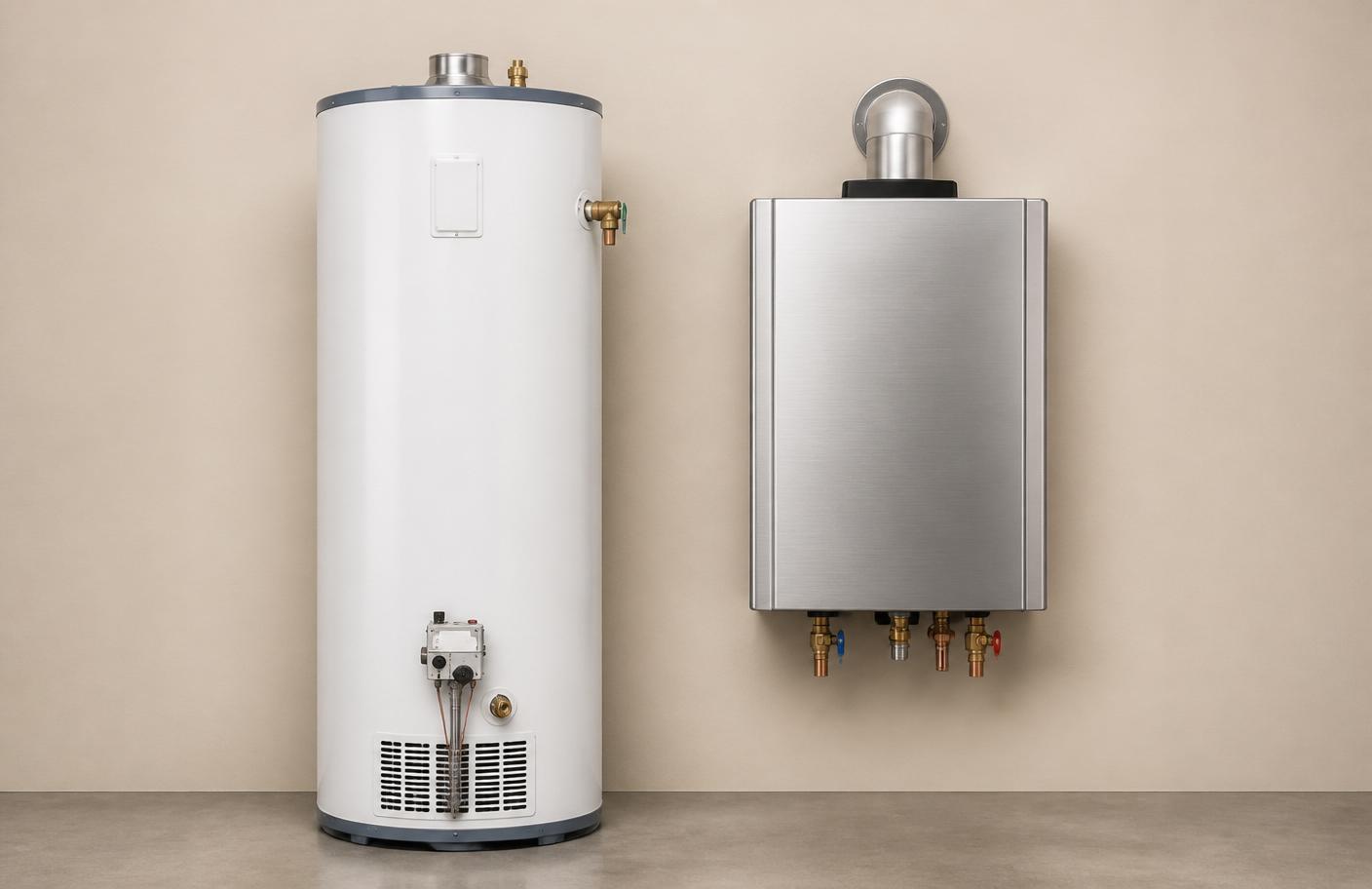
Water Heater Maintenance in Arvada
Water heater maintenance is the least glamorous item on any Arvada homeowner's list and easily the highest-return one. A tank water heater is a steel vessel full of hot mineral water with a burner underneath it. Left alone, it accumulates sediment, consumes its own corrosion protection, and slowly cooks itself from the bottom up. Serviced annually, the same appliance stays efficient and keeps running years past the point where its neglected twin down the street failed.
The numbers are not subtle. Across the Arvada homes we maintain, tanks on an annual service schedule commonly reach fourteen to sixteen years. Tanks we are called out to for the first time at year ten — original anode rod, never flushed — are frequently beyond saving. Same brands, same water, same neighborhoods. The variable is maintenance.
There is a second benefit that homeowners underrate: maintained heaters fail politely. They give you a rust stain, a weep, a warning you can act on during business hours. Neglected heaters go from apparently fine to fifty gallons on the basement floor with no intermediate stage.
This page explains exactly what maintenance involves, what our water does to your equipment, what it costs, and what you can reasonably do yourself between visits.
What Annual Water Heater Maintenance Includes
Our maintenance visit is a genuine inspection and service, not a quick drain and a checkbox. It takes about an hour on a tank unit and roughly ninety minutes on a tankless system, and it produces a written condition report you can actually use for planning.
On a tank heater, we start with a full power flush. That means draining under pressure and, on heavily scaled Arvada tanks, using a curved wand to break up the hardened layer that a simple gravity drain leaves untouched. A partial drain on a ten-year-old tank moves loose sediment and leaves the crust that is actually causing the problem.
Next comes the anode rod. We pull it, photograph it and show you what is left. If it is down to the core wire, we recommend replacement on the spot — this is the single item that most affects how many more years you get. Arvada water typically consumes an anode by year five.
Then safety and calibration: testing the TPR valve, checking discharge routing, verifying expansion tank pre-charge, measuring actual delivered temperature at the nearest tap, and recalibrating to 120°F. On gas units we also verify the burner flame pattern, draft and combustion air — which matters more at our altitude than most people expect.
Finally, an honest condition assessment. Tank age from the serial number, corrosion status, sediment level, and a realistic estimate of remaining service life. That last item is what lets you plan a replacement rather than react to one.
Water Heater Flushing
Pressurized flush with sediment breakup on scaled tanks — not a partial gravity drain.
Anode Rod Inspection
Physically removed, inspected and shown to you. Replaced when it is down to the core wire.
Water Heater Safety System Testing
TPR valve operation and discharge routing, expansion tank charge, gas connections and combustion check.
Written Water Heater Condition Report
Tank age, corrosion status, sediment level and an honest estimate of remaining service life.
What Happens Without Annual Water Heater Maintenance
Here is what actually happens inside an unmaintained water heater in Arvada, in the order it happens.
Water Heater Sediment Buildup
Dissolved minerals precipitate out when heated and settle on the tank floor. Within a few years the deposit hardens into a crust that a simple drain cannot remove.
Declining Water Heater Efficiency
The burner now heats through an insulating layer instead of directly into water. Burn cycles lengthen, gas usage climbs, and the change is gradual enough that nobody notices it happening.
Reduced Hot Water Capacity
Every inch of sediment is volume that is no longer holding hot water. A 50-gallon tank effectively becomes a 42, then a 38 — which is why hot water starts running out sooner.
Tank Overheating and Steel Fatigue
Heat trapped under the sediment drives the tank bottom well above design temperature. That localized overheating is what cracks the protective glass lining.
Anode Rod Fully Consumed
Around year five in Arvada water. From that moment on, every corrosive process in the tank is attacking the steel vessel instead of the sacrificial rod.
Water Heater Tank Corrosion and Rust
Invisible from outside and irreversible. This is the process that ultimately produces the leak, and it runs for years before any evidence appears.
Water Heater Popping and Rumbling Noise
Rumbling and popping as water flashes to steam beneath the crust. This is the tank telling you plainly that stage four has been underway for a while.
Pressure Relief Valve Seizing
A safety valve that is never tested can corrode shut. That removes the last protection against an overpressure event, which is the genuinely dangerous scenario.
Premature Water Heater Failure
Usually somewhere between year nine and year twelve for an unmaintained Arvada tank, and usually without any final warning at all.
Signs Your Water Heater Needs Service
Your water heater will tell you it is overdue for service long before it tells you it is failing. These are the signals.
- Popping, rumbling or ticking when the burner fires
- Hot water running out faster than it used to
- Longer recovery time between back-to-back showers
- Any discoloration or metallic taste on the hot side
- A sulfur or rotten-egg smell from hot taps only
- Gas or electric bills rising with no usage change
- Water temperature that fluctuates during a shower
- Sediment or grit showing up in aerators and faucet screens
- The TPR valve has never been tested
- You cannot remember the last flush — or there has never been one
- The unit is past year four and the anode is original
- A tankless unit that has gone more than twelve months without descaling
Why Arvada Water Heaters Need Yearly Flushing
Why maintenance matters more in Arvada than in many other places comes down to a few specific local conditions.
Hard Water in Arvada
Arvada's supply, drawn largely from Clear Creek and Ralston Reservoir, is clean and well treated but carries enough dissolved calcium and magnesium to build meaningful scale over a decade of heating cycles.
Cold Winter Inlet Water Temperatures
Incoming water dropping toward the low 40s in January means longer burn times and more thermal cycling, both of which accelerate scale formation and material fatigue.
Altitude and Combustion at 5,300 Feet
At 5,300 feet, gas appliances need correct derating and genuinely adequate combustion air. Annual verification catches drift before it becomes sooting or nuisance shutdowns.
High Water Pressure
Parts of Arvada see pressure that stresses tanks and valves. Checking expansion tank pre-charge annually is what keeps that pressure from working against the tank seams.
Thermostats Set Too High
Every ten degrees above 120°F meaningfully accelerates mineral precipitation. Annual calibration catches the dial that got turned up two winters ago and never turned back.
Anode Rods Never Replaced
Most homeowners have never heard of the component that determines their tank's lifespan. It is the single most commonly neglected part on any water heater.
Water Heaters Hidden in Finished Basements
A heater behind a utility door in a finished Arvada basement is out of sight, and out of sight means the early rust ring goes unnoticed for months.
Tankless Water Heaters Treated as Maintenance-Free
The marketing implies set-and-forget. In our water, an undescaled tankless unit can lose more than half its potential service life.
Water Heater Flushing and Sediment Removal Services
Everything included in our Arvada maintenance service, plus the add-ons that make the biggest difference.
Water Heater Flushing and Sediment Removal
Pressurized draining with sediment agitation to remove the hardened layer, not just the loose material a gravity drain carries out.
Anode Rod Replacement
Pulled, photographed and assessed. Segmented anodes available for tanks with low overhead clearance in tight Arvada utility rooms.
Pressure Relief Valve Testing
Operation verified and reseating confirmed, plus a review that the discharge line is routed legally and terminates correctly.
Thermostat Temperature Calibration
Delivered temperature measured at the nearest tap with an independent thermometer and adjusted to a true 120°F.
Expansion Tank Verification
Pre-charge checked against your measured static pressure and recharged or replaced when it has lost its bladder.
Combustion and Draft Inspection
Flame pattern, draft, vent condition and combustion air assessed for altitude — the checks that prevent sooting and CO risk.
Tankless Water Heater Descaling
Full recirculating descale of the heat exchanger, inlet filter screen cleaning, flame rod service and condensate neutralizer check.
Sediment Trap and Connector Inspection
Gas sediment trap verified, flex connectors inspected for corrosion, and dielectric unions confirmed at the tank nipples.
Annual Water Heater Maintenance Plan
Scheduled yearly visit, priority booking, discounted repair labor and a documented service history that supports warranty claims.
Our Annual Water Heater Maintenance Checklist
An hour, once a year, run the same way every time.
- 1
Water Heater Inspection
Tank age from the serial number, external corrosion, connections, venting, pan and surroundings, plus a look at how the unit is actually installed.
- 2
Isolation and Draining
Fuel and cold supply shut down safely, the tank allowed to cool appropriately, and a hose run to a drain or outside.
- 3
Power Flush and Sediment Removal
Pressurized flush with agitation until the discharge runs clear. On badly scaled tanks we use a curved wand to reach the hardened crust.
- 4
Anode Rod Pull and Safety Testing
Anode removed and assessed, TPR valve tested and reseated, expansion tank pre-charge checked, gas connections leak-tested.
- 5
Refill, Fire and Calibrate
Tank refilled and air purged, unit fired, combustion and draft verified, thermostat calibrated to a true 120°F at the tap.
- 6
Written Report and Preventative Maintenance Plan
Condition summary, anode status, sediment level, estimated remaining life and a plain recommendation on when to start budgeting for replacement.
Water Heater Maintenance Cost in Arvada
Maintenance pricing is simple, and it is the cheapest line item on this entire website relative to what it prevents.
| Scope of work | Typical range |
|---|---|
Annual tank flush & tune-up Full power flush, anode inspection, TPR test, calibration, combustion check and written report. | $149–$229 |
Tankless descaling service Recirculating descale, inlet screen clean, flame rod service and condensate neutralizer check. | $189–$279 |
Anode rod replacement Added when the rod is spent. Higher end for seized rods or segmented anodes in low-clearance installs. | $210–$390 |
Expansion tank replacement When the bladder has failed and the tank no longer holds its pre-charge. | $260–$450 |
TPR valve replacement When testing reveals a valve that will not reseat or has corroded in place. | $180–$320 |
Two-unit household service For larger Arvada homes running two water heaters, serviced in the same visit. | $249–$369 |
Annual maintenance plan Scheduled yearly service, priority booking, 10% off repair labor and no after-hours surcharge. | $179/year |
Why the range is a range
- Flat-rate pricing, no hourly surprises
- Written condition report included with every visit
- Anode replacement quoted before we install it — never assumed
- Documented service history supports manufacturer warranty claims
- Plan members get priority scheduling during winter peak
- Service reminders sent so you do not have to track the date
Extend the Life of Your Water Heater
The return on one hour a year, measured across the Arvada homes we service.
Four to Six Extra Years of Water Heater Life
Maintained tanks in Arvada commonly reach fourteen to sixteen years. Neglected ones frequently fail between nine and twelve. Same equipment, same water.
Lower Operating Cost
A sediment-free tank transfers heat directly into water. Removing years of buildup measurably shortens burn cycles and cuts energy use.
Early Warning Before Failure
Serviced heaters get inspected annually, which means problems are found as a rust stain rather than as fifty gallons on a finished floor.
Warranty Protection
Most manufacturers require documented maintenance for tank warranty claims. A service history turns a denied claim into an approved one.
Preventing Water Heater Failure Between Visits
What you can reasonably do yourself between our visits, and what is worth leaving alone.
Look at the unit every couple of months. That is genuinely it for the most valuable habit: check the base for moisture, rust or mineral crust, glance at the fittings for corrosion, and make sure nothing has been stacked against a gas unit blocking combustion air. Ninety percent of the catastrophic tank failures we attend in Arvada were visible as a small stain months before they became emergencies.
Test the TPR valve yourself once a year if you are comfortable doing it. Lift the lever briefly and let it snap back. Water should discharge and then stop cleanly. If it dribbles afterward or if nothing happens at all, call — that is the most important safety device on the appliance and it is the one most likely to be quietly seized.
Keep the temperature at 120°F and resist the urge to turn it up. If hot water is running out, the answer is almost always sediment, a failing element or a capacity mismatch, and turning up the dial accelerates the scale problem that is causing it in the first place.
Leave the deep work to us. A partial drain on a tank that has never been flushed can dislodge sediment into the drain valve and jam it open, and pulling a seized anode rod without the right impact tooling can damage the tank fitting. Those are the two DIY jobs that turn a maintenance afternoon into an emergency call.
- Visually inspect the tank base every two months
- Test the TPR valve annually
- Keep the thermostat at 120°F
- Keep 18 inches clear around a gas unit for combustion air
- Rinse tankless inlet filter screens quarterly
- Note the manufacture date from the serial number
- Schedule the professional flush at the same time each year
- Keep service records with your home documents
Water Heater Maintenance FAQs
Related Water Heater Services in Arvada
Water Heater Repair
When maintenance uncovers a failed component, here is what repair involves and what it costs in Arvada.
Read moreTankless Water Heaters
Annual descaling is mandatory on tankless in our water. The complete Arvada tankless guide.
Read moreWater Heater Replacement
When the condition report says the tank is near the end, plan the replacement on your own schedule.
Read moreOne hour a year. Years of extra life.
Book an annual flush and tune-up and get a written condition report telling you exactly where your water heater stands — including an honest estimate of how much life is left in it.